

Presuming Competence in AAC: Are you Living It or Just Saying It?
Updated: Jun 10
A group of our REV students walked into a room full of strangers and communicated with them. Not with their trusted communication partners who know their rhythms and nuances, but with people they had never met before. They managed their bodies, regulated their emotions, organized their thoughts, and worked to communicate what they wanted to say, all while working with someone brand new.
If you do not understand how extraordinary that is, let me explain.

Our students communicate through text-based multimodal AAC. That means every word requires sustained control over gross and fine motor movements, body regulation, and cognitive execution, all at the same time.
For many of our students, there is a disconnect between brain and body, often called apraxia, that makes this process exhausting in a way most people will never fully appreciate.
Autism is a motor disorder, not a cognitive impairment. Our students understand far more than they can physically show, and produce communication all while fighting to stay on top of what their bodies are doing while thinking through what they want to say. Doing that with a stranger who does not yet know you? That is incredibly difficult. And every single one of our students did it.
They did it because they believe in this work.
They did it because communication access matters that much to them.
That is what happened at Reach Every Voice's first local Communication Partner Skill Builder workshop. And it changed me.
How We Got There
The workshop brought together participants, almost all of them parents, who wanted to become better communication partners for their children. They came to learn, and they came ready to do the work. The first part of the workshop focused on the "why" behind everything we do at REV, and at the center of that conversation was a single, powerful idea: presuming competence.
Our students communicate. Let that be the starting point. They may not communicate through verbal speech, but they have things to say, and they have the right to say them.
Communication is a human right.
Presuming competence means we believe that from the start, and then we do whatever it takes to provide access in a way that works for each person.
It means we bring age-appropriate, meaningful content to our students and give them communication tools and supports from the beginning, not as a last resort.
It does not mean we assume our students already know everything. It means the least dangerous assumption we can make is that they are capable of learning anything when given the right communication access and support.
Then Our Students Showed Us What That Actually Looks Like
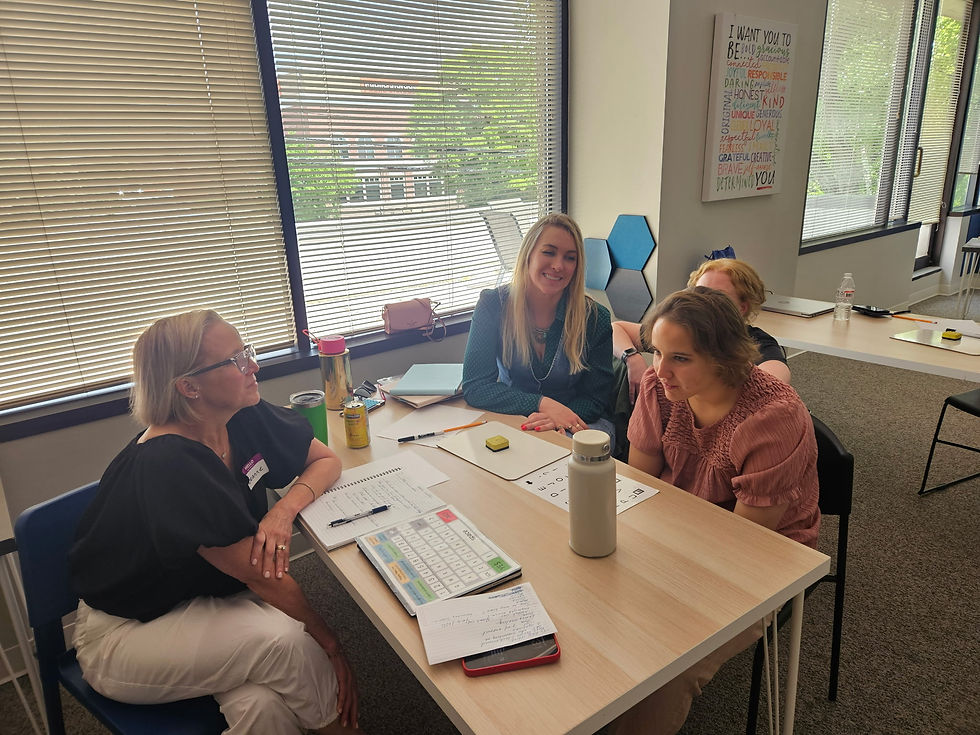
After that foundation was set, our participants got to put it into practice. They worked one-on-one with our REV students, and the learning went both ways. There were big feelings in the room, excitement as well as anxiety and uncertainty, from everyone. And everyone challenged themselves to show up anyway.
But the most powerful part of the workshop was what came next.
Our students were given the floor.
They provided direct feedback to the participants on how to improve. They answered questions in real time. And they did it all with a confidence that filled the room.
Most of the questions centered on how to build trust and increase communication. And every single time, our students brought it back to the same place: presume competence. Believe that I am here. Believe that I am capable. That is where it starts.
And every single time, our students brought it back to the same place: presume competence. Believe that I am here. Believe that I am capable. That is where it starts.

Their feedback was not complicated or critical. It was generous. And that generosity is what made it land so hard. Because if what our students are asking for is simply to be believed in, it forces you to ask yourself why that has ever been a question in the first place.
What our students did that day was not just impressive. It was brave. And it was a choice they made willingly, because being heard is worth the cost. That is the invisible labor, the kind that most people never see.
And that invisible labor goes even further than most people realize. Our students accommodate us far more than we accommodate them.
As they grow in their communication and move toward more open-ended expression, they are constantly reading us. If we are not following, if we are not quite getting it, they will adjust their message, tweak their wording, and find another way to reach us.
They do that work for us, patiently and gracefully, because they want to communicate with us that badly. Our students are often the most accommodating and patient people in the room, and most of the time we do not eve
n notice.
And all they ask in return is that we believe in them.
I watched people who are so often spoken about, decided for, and underestimated stand in their expertise and teach a room full of participants.
They were proud.
They were excited.
They were included.
And they were showing everyone exactly what happens when someone finally believes in you and gives you the access to show it.
I will not pretend I held it together.

The Simplest Truth Is Often the Hardest to Practice
Presuming competence can sound deceptively simple. Of course we believe in our kids. Of course we think they are capable.
But our students reminded everyone in that room that the gap between believing it and truly living it is where the real work happens.
They are already doing their part. They are meeting us more than halfway. They are doing the hardest work in the room and making it look easy, and they are doing it because they believe this matters.
Their message was not complicated: Believe in us. Believe that we are present. That is the bottom line.
Their message was not complicated: Believe in us. Believe that we are present. That is the bottom line.
Imagine a world where every person was met with that belief from the start. Where we led with trust instead of testing, with access instead of gatekeeping, with patience instead of proof.
Our students are already showing us what that world looks like. The question is whether the rest of us are ready to follow their lead.
Want to join our next in-person Communication Partner Skill Building Intensive? Learn more here.

What would it mean to truly presume competence — not as a goal on an IEP, but as the first thing you believe before a student ever walks in the room?
If you're looking for a way to get started and take small steps to change how you teach the learners who feel most difficult to reach, we encourage you to check out our Accessible Academics course. This self-paced course is full of real-life, easy-to-implement steps that you can do at home or in your classroom that just might reenergize your teaching and help you feel like you're taking action toward meeting your students needs as true learners.

Erin Buchanan is the Program Director and a Communication Teacher at Reach Every Voice. She teachers our Gaithersburg Co-Op, coordinates group programs, and provides one-on-one communication instruction for students in our Gaithersburg and Severna Park locations.


.png)

.png)


.png)


Comments